 Warble


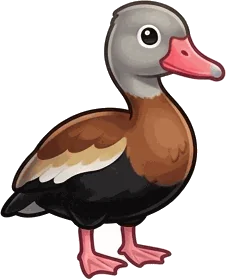
A Black-bellied Whistling-Duck sounds like a squeaky toy that learned to whistle. The Smithsonian's National Zoo describes a soft, wheezy whistle followed by several more notes, and Audubon calls the voice mellow whistles mixed with chatter. They travel in noisy, sociable flocks, sometimes hundreds strong, and because they feed mainly at night, the whistling often passes overhead in the dark. Listen for it in southern Texas, Louisiana, Florida and Arizona, around shallow ponds, marshes and farm fields.
What the whistle sounds like
The signature call is a whistle, and it is nothing like a duck. It starts with a soft, slightly wheezy note and runs on into a few more, so the whole thing has a bouncy, squeaky quality, the way a rubber toy sounds when a dog works it a few times in a row. The National Zoo makes that exact comparison. Audubon's description is shorter: mellow whistles, with an up-and-down, undulating pattern.
If you are near a pond in south Texas or Florida and something overhead is whistling in rising and falling bursts, look for long-necked ducks with a broad white patch flashing on each wing.
Flock chatter
Besides the whistle, black-bellies keep up a running exchange of chattering calls and chirps that help a flock stay together. They are highly sociable, often gathering in noisy flocks of hundreds. In parts of coastal Texas, landowners scatter corn near their ponds to draw them in, and hundreds may arrive.
Pairs are unusually loyal. A male and female may stay together for many years, possibly for life. Both parents share the incubation, which lasts 25 to 30 days, and both tend the ducklings.
When and where you hear it
In the United States this is a bird of the far south, most common near the Mexican border. It lives in southern Texas, Louisiana, Arizona and Florida and turns up rarely elsewhere in the South. Look and listen around shallow freshwater ponds and lakes ringed with trees, fresh marshes, open-country ponds, harvested grain fields, prairies and pastures. The birds forage mostly on land, picking up seeds and waste grain, with smartweed and grass seeds high on the list; insects and snails make up less than a tenth of the diet.
The best time to hear them is after dark. They feed mainly at night, though they are active around the clock. Many stay year-round, but birds at the northern edge leave in winter, and small flocks sometimes wander far north of the usual range. The population has grown greatly since the 1950s. In Arizona the species was very rare before 1949 and now nests fairly commonly. In Warble it is a card in the Texas album and a rare one in Louisiana and Florida.
Ducks in the trees
Black-bellied Whistling-Ducks often rest on low snags over the water and will perch high in dead trees, a strange sight if you expect ducks to stay on the pond. They nest in tree cavities and broken-off stubs, usually 4 to 20 feet up and close to water, though sometimes up to a quarter mile away. Some nest on the ground in dense vegetation, and in Arizona most nests are on the ground. They have also used chimneys and barns.
Nest boxes have been a big part of their success, and Audubon credits them with helping the expansion in Texas and eastern Mexico. A clutch is often a dozen eggs or more, and females sometimes lay in each other's nests, producing dump nests that can hold around 60 eggs. A day or two after hatching, the ducklings climb out of the cavity and jump to the ground. They find all their own food and fly at about two months.
What it looks like
A tall duck about 19 to 21 inches long, with a long neck, long pink legs and a bright pink bill. The face and upper neck are gray, the chest and back rich chestnut, and the belly black, which gives the bird its name. In flight a broad white patch flashes across the dark wings. Males and females look alike. Young birds are duller with a gray bill but show a hint of the adult pattern.
Birds that sound similar
- ?Fulvous Whistling-Duck
Its call is a hoarse, two-part ka-wheee, not the black-belly's squeaky whistle with several notes trailing after it. Fulvous birds feed in rice fields and marshes and rarely perch in trees, while black-bellies often sit on snags and dead branches.
 Wood Duck
s share wooded ponds and nest boxes. The female's loud wooo-eeek! is a single squeal, and the male's jeee or ter-weeeee is soft and thin. A noisy flock whistling as it flies over, especially at night, is whistling-ducks.
Where the Black-bellied Whistling-Duck card lives
In Warble the same bird can be an easy card in one state and a prized one in another, because each album ranks its birds by how often people really report them there. The Black-bellied Whistling-Duck appears in 3 state albums:
 Heard one? Open Warble, tap the green button while it sings, and the Black-bellied Whistling-Duck card flips into your album. Get the app free.
Questions people ask
Why is it called a whistling duck?
Because its signature call is a whistle: soft, wheezy and followed by several more notes, often compared to a squeaky toy. Flocks add a running chatter of calls and chirps that help them stay together.
Why do black-bellied whistling ducks sit in trees?
They are tree-nesting ducks. They rest on snags and dead branches over the water and nest in tree cavities, broken stubs and nest boxes, usually 4 to 20 feet up. The ducklings leap to the ground a day or two after hatching.
Why do I hear whistling ducks at night?
Because they feed mainly at night. Flocks fly between their roosts and fields and ponds after dark, keeping in touch with whistles and chatter as they go.
Will black-bellied whistling ducks use a nest box?
Yes, readily. Nest boxes have helped the species spread in Texas and eastern Mexico, and many pairs now use them instead of natural tree cavities.
Sources
- National Audubon Society, Guide to North American Birds: Black-bellied Whistling-Duck. www.audubon.org/field-guide/bird/black-bellied-whistling-duck
- Smithsonian's National Zoo and Conservation Biology Institute: Black-bellied whistling duck (whistle, flocks, night feeding, range). nationalzoo.si.edu/animals/black-bellied-whistling-duck
- National Audubon Society, Guide to North American Birds: Fulvous Whistling-Duck. www.audubon.org/field-guide/bird/fulvous-whistling-duck
- National Audubon Society, Guide to North American Birds: Wood Duck. www.audubon.org/field-guide/bird/wood-duck