 Warble

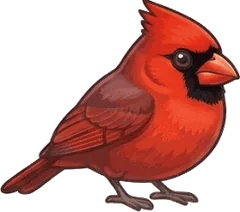
Listen to the shape of the song. A Northern Cardinal whistles: clear, slurred notes such as what-cheer, what-cheer, wheet-wheet-wheet, one phrase repeated several times before it switches to another, and its call is a short, metallic chip. A Summer Tanager sings like a softer, sweeter American Robin, a two-to-four-second run of slurred phrases from high in the trees, and its call is a dry, rattling pit-titi-tuck. If you can see the bird, check the head: the cardinal has a raised crest and a black mask, the all-red tanager has neither.
Side by side
| Summer Tanager | Northern Cardinal | |
|---|---|---|
| Song | Robin-like caroling of slurred phrases, softer and sweeter than a robin, 2 to 4 seconds long | Clear whistles that slide up or down, such as what-cheer or cheer, cheer, cheer; each phrase repeated, then changed |
| Call | Dry, sharp, rattling pit-titi-tuck or chick-tucky-tuck, stressed on the first note | Short, sharp, metallic chip |
| Adult male | Rosy red all over, wings and tail a shade darker; no crest, no mask, large pale bill | Crimson red with a raised crest and a black mask around a coral-red bill |
| Female | Mustard yellow to ochre, no crest | Grayish brown with red tinges on the crest, wings and tail; same crest and coral bill |
| Size | 6.7 to 7.5 inches | 8 to 9 inches |
| Where it feeds | High in oaks and pines, often hidden in the leaves | Low: hopping on the ground, in shrubs and at feeders |
| Where and when | Spring to early fall in southern oak and pine woods and southwestern streamside groves | All year in thickets, woodland edges, yards and towns |
By ear: a repeated whistle or a soft robin
A cardinal's song is built from clear whistles, each note sliding up or down. The bird picks one pattern, repeats it several times, then changes to another: what-cheer, what-cheer, wheet, wheet, wheet, then later cheer, cheer, cheer, what, what, what. Males sing from a treetop or another high perch to defend a territory, and females sing too, mostly in spring before nesting.
A Summer Tanager does not repeat one phrase like that. Its song is a melodious, slurred caroling, two to four seconds long, that Audubon compares to an American Robin's, only softer and sweeter. Missouri's field guide notes a few prit-ti-voy phrases in most songs. A cardinal sounds like someone practicing one whistle, and a tanager sounds like a robin that has lowered its voice. The tanager also tends to sing from high in the canopy, out of sight among the leaves.
The calls are even easier. A cardinal's call is a single short, metallic chip, given as an alarm when a predator comes near the nest. A Summer Tanager's is dry, sharp and rattling, a stuttering pit-titi-tuck that Audubon writes as chick-tucky-tuck, with the weight on the first note. One clean chip from a hedge is a cardinal; a quick, stuttering rattle from the treetops is the tanager.
By sight: the crest, the mask and the bill
Audubon calls the Northern Cardinal "our only red bird with a crest," and that is the mark to check first. The male is brilliant crimson, darker on the back and wings, with a raised crest and a black mask that runs from the eyes down to the top of the chest, framing a big coral-red bill. A male Summer Tanager is rosy red all over, a little darker on the wings and tail, with a smooth, rounded head, no mask, and a large pale bill. He is also smaller, 6.7 to 7.5 inches against the cardinal's 8 to 9.
A female cardinal is grayish brown with a reddish tint on her crest, wings and tail, and she keeps the crest and the coral bill, so her shape gives her away. Young cardinals look like her but start out with a grayish-black bill. A female Summer Tanager is a plain mustard yellow to ochre with no crest at all. A young male tanager in his first summer is blotched red and yellow, as if halfway through a paint job.
Behavior helps too. Cardinals feed low, hopping on the ground and through shrubs, and come to feeders for sunflower seed. Summer Tanagers move slowly through the treetops and dart out to catch insects in flight, bees and wasps above all, whacking each one against a branch to remove the stinger.
Where you will meet each one
The Northern Cardinal is a permanent resident. It lives from Maine and Minnesota south to Texas, and in New Mexico, southern Arizona and southern California, and it has been pushing north for decades, possibly helped by backyard feeders. It wants brushy, semi-open places with dense cover: woodland edges, thickets, gardens, city parks and, in the Southwest, mesquite and streamside brush.
The Summer Tanager is a summer bird, as the name says. In the Southeast it breeds in dry, open woods of oak, hickory or pine; in the Southwest it uses cottonwood and willow groves along streams. In Missouri it is present from May through the first week of October, common in the southern two-thirds of the state. It winters from central Mexico to Bolivia and Brazil, and some cross the Gulf of Mexico to get there.
Old country names captured the calendar: the tanager was the summer redbird, the cardinal the winter redbird that stays all year. So between fall and spring, a red bird in your yard is not a Summer Tanager. In summer, in southern oak woods, you can have both: the cardinal chipping in the thicket, the tanager rattling overhead.
 Still not sure which one is outside? Warble listens while it sings and tells you, then adds the card to your album. Get the app free.
Questions people ask
What red bird looks like a cardinal but has no crest?
A male Summer Tanager fits that description. He is rosy red from head to tail with a smooth, round head, no black mask and a large pale bill. The Northern Cardinal is the only red bird with a crest, and even the brown female has one.
Do Summer Tanagers come to bird feeders?
Sometimes, if the feeder offers fruit, but a Summer Tanager spends most of its time high in the trees catching bees and wasps. A red bird eating sunflower seed is almost certainly a cardinal.
Why was the Summer Tanager called the summer redbird?
To tell it from the cardinal, the winter redbird, which stays all year. The tanager comes in spring and leaves in early fall for the tropics.
Sources
- National Audubon Society, Guide to North American Birds: Summer Tanager. www.audubon.org/field-guide/bird/summer-tanager
- National Audubon Society, Guide to North American Birds: Northern Cardinal. www.audubon.org/field-guide/bird/northern-cardinal
- Missouri Department of Conservation field guide: Summer Tanager (song, call, summer redbird, seasons). mdc.mo.gov/discover-nature/field-guide/summer-tanager
- Wikipedia: Northern cardinal (song patterns, mask, bill, range). en.wikipedia.org/wiki/Northern_cardinal