 Warble
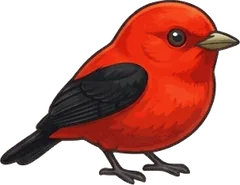

Listen for the call, because the songs are close. A Scarlet Tanager calls a distinctive two-part chip-burr; a Summer Tanager gives a dry, rattling pit-titi-tuck stressed on the first note. Both sing a robin-like series of phrases from high in the trees, but the Scarlet's is hoarse and burry while the Summer's is softer and sweeter. If you can see a male, the wings settle it: a Scarlet is bright red with black wings and tail, a Summer Tanager is rosy red all over, and he stays that way all year.
Side by side
| Scarlet Tanager | Summer Tanager | |
|---|---|---|
| Song | Robin-like but hoarse and very burry: queret-querer-queer-queret | Robin-like but softer and sweeter, 2 to 4 seconds, often with a few prit-ti-voy phrases |
| Call | A two-part chip-burr or chip-churr | A dry, rattling pit-titi-tuck or chick-tucky-tuck, stressed on the first note |
| Breeding male | Deep scarlet with black wings and tail | Rosy red all over, wings and tail a shade darker |
| Male after nesting | Molts to yellow-olive, blotchy at first; keeps black wings and tail | Stays red all year |
| Female | Yellow below, olive above, olive-gray wings and tail | Mustard yellow to ochre, more orange-toned; wings barely darker than the body |
| Bill | Pale and fairly stout | Noticeably larger and pale |
| Where and when | Large oak forests of eastern North America, mid-April to mid-October; winters in northwestern South America | Southern oak, hickory and pine woods and southwestern streamside groves, May to early October; winters from Mexico to Bolivia and Brazil |
By ear: the call settles it
Both tanagers sing a song that sounds like an American Robin's, delivered from high in the canopy, often by a bird hidden in the leaves. The difference is the voice. A Scarlet Tanager sounds hoarse, as if the robin had a cold: Missouri's field guide calls it very burry and writes it queret-querer-queer-queret. A Summer Tanager's song is melodious and slurred, softer and sweeter than a robin's, two to four seconds long, often with a few prit-ti-voy phrases mixed in. Burry means Scarlet, sweet means Summer.
That works with practice, but it is not foolproof. Wikipedia's account of the Scarlet Tanager says its song is only slightly different from the Summer Tanager's. So wait for the call, which is far easier to tell apart.
The Scarlet's call is a two-part chip-burr or chip-churr, the second half a burr. The Summer Tanager's is a dry, sharp, rattling stutter, pit-titi-tuck, which Audubon writes as chick-tucky-tuck, with the weight on the first note. A chip and a burr is a Scarlet; a dry, stuttering rattle is a Summer.
By sight: black wings or red ones
A breeding male Scarlet Tanager is the easiest call of the pair: an intense scarlet body with black wings and tail. Its red is deeper than a Summer Tanager's, and neither the Summer Tanager nor the Northern Cardinal has black wings. The male Summer Tanager is rosy red from head to tail, with wings and tail only a shade darker. Look at the bill, too: the Summer Tanager's is noticeably larger.
Late summer scrambles the picture. After nesting, the male Scarlet molts into plumage like the female's, and for a while he is blotched with scarlet and yellow-olive. But he keeps his black wings and tail, so a yellow-green tanager with black wings is still a male Scarlet. The Summer Tanager male keeps his red all year. The bird that confuses people is a young male Summer Tanager in his first spring and summer, blotched red and yellow, sometimes with a red head. His wings are never black.
Females are trickier. A female Scarlet is yellow below and olive above, with darker, olive-gray wings and tail, so the wings stand out a little from the body. A female Summer Tanager is mustard yellow to ochre, warmer and more orange-toned, less green than a female Scarlet, and her wings are only vaguely darker than the rest of her. Add the bigger bill, and you have two good clues.
Where you will meet each one
The Scarlet Tanager breeds in large deciduous forests across eastern North America, especially where oaks grow, and it needs real forest: a breeding population requires at least 10 to 12 hectares, roughly 25 to 30 acres, of woods. In Missouri it is found statewide but tied to oaks on the upper slopes and ridges of mature forest, present from mid-April to mid-October, with peaks in mid-May and mid-September. It winters in northwestern South America.
The Summer Tanager is a southern bird. In the Southeast it breeds in dry, open woods of oak, hickory or pine; in the Southwest, in cottonwood and willow groves along streams. In Missouri it is present from May to the first week of October, common in the southern part of the state and uncommon in the north, in pine-oak forest, bottomland woods and parks, often near creeks and rivers. It winters from central Mexico to Bolivia and Brazil.
Where both nest, the setting gives a hint before you hear a note: ridgetop oaks in big forest for the Scarlet, bottomlands, streamsides and open pine-oak woods for the Summer. And in mid-May or mid-September, a migrant Scarlet can turn up in a park with tall trees, which is when the call earns its keep.
 Still not sure which one is outside? Warble listens while it sings and tells you, then adds the card to your album. Get the app free.
Questions people ask
What is the difference between a Scarlet Tanager and a Summer Tanager?
The call and the wings. A Scarlet calls chip-burr and the male has black wings and tail; a Summer Tanager gives a rattling pit-titi-tuck and the male is red all over, wings included. The Scarlet's song is burry, the Summer's softer and sweeter.
What red bird has black wings?
A breeding male Scarlet Tanager: deep scarlet with black wings and tail. Neither the Summer Tanager nor the Northern Cardinal has black wings, so that combination is the Scarlet's alone among them.
Do Scarlet Tanagers stay red all year?
No. After nesting the male molts into a yellow-olive plumage like the female's, blotchy for a while, but he keeps his black wings and tail. The male Summer Tanager stays red all year.
Sources
- Missouri Department of Conservation field guide: Scarlet Tanager (song, call, similar species, seasons). mdc.mo.gov/discover-nature/field-guide/scarlet-tanager
- Wikipedia: Scarlet tanager (plumage, song and call compared with Summer Tanager, range, forest size). en.wikipedia.org/wiki/Scarlet_tanager
- National Audubon Society, Guide to North American Birds: Summer Tanager. www.audubon.org/field-guide/bird/summer-tanager
- Missouri Department of Conservation field guide: Summer Tanager. mdc.mo.gov/discover-nature/field-guide/summer-tanager