 Warble


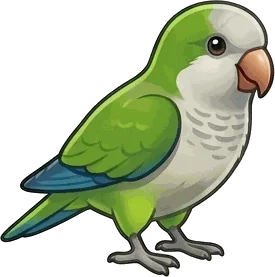
A Monk Parakeet sounds like a flock arguing at full volume: loud, harsh, screeching eeeh-eeeh calls and throaty chatter, given as the birds fly over in groups or gather around their huge stick nests. It is an introduced South American parrot, and in the United States you hear it in city colonies, especially in Florida, the Texas cities of Austin, Dallas and Houston, Brooklyn and Queens in New York, and Chicago's parks.
What it sounds like: loud squawks
Monk Parakeets do not sing in the songbird sense. What they have instead is a set of loud, rough calls. Audubon describes the main call as a loud, harsh, screeching eeeh-eeeh, flat in pitch and repeated, and lists rattles and raucous squawks alongside it. Wikipedia renders the everyday voice as a throaty chape or chape-yee, or a run of quak quaki quak-wi quarr, plus a sharper screech, skveet.
Because the birds live in colonies and travel in flocks, you seldom hear a lone call. If harsh squawks are coming from a big tangle of sticks on a utility pole or in a tree, you have found them.
Up close: chatter, dialects and talking
Listen long enough and the noise turns out to have structure. Research summarized on Wikipedia suggests that Monk Parakeets may have individual voice prints that let them recognize one another, and feral birds around Milford, Connecticut, use three distinct vocal dialects. Pet Monk Parakeets often pick up large vocabularies of words and phrases.
When and where you hear it
The species is native to temperate and subtropical South America, from Argentina, Uruguay and Paraguay to southeastern Bolivia and southwestern Brazil. Thousands were imported to the United States as pets from the 1960s to the 1980s, and many escaped or were set loose. Their descendants now form colonies in many North American cities, though despite early predictions they have not spread widely into the countryside.
Florida's population is estimated at 150,000 to 500,000 birds. Texas has established populations in Austin, Dallas and Houston. In New York the colonies are in Brooklyn and Queens, including Green-Wood Cemetery, and the birds favor utility poles, which may be why they have not moved into Manhattan, where the wiring is underground. Chicago has around 1,000 birds in several parks, and residents of Hyde Park have pushed back against efforts to remove them. There are also feral birds in Connecticut, and in Bergen County, New Jersey, nests are removed in spring.
Colonies stay put through the year, so you can hear them in any month. They are one of the few parrots of temperate climates and cope with cold weather, helped partly by nesting on warm electrical equipment. In Warble the Monk Parakeet is not in any single state's top 100, so it lives in the national album as an uncommon card.
The stick-nest colonies
Most parrots nest in tree holes. Monk Parakeets build their own bulky nests of sticks in trees or on structures such as utility poles, and they use them both for raising young and for sleeping at night. Pairs often build side by side, each with its own entrance, until the combined nest grows to the size of a small car, sometimes with other birds or mammals moving in. Utilities have reason to dislike them: nests on warm electrical equipment create a fire risk and can damage poles.
What it looks like
A medium-sized parrot about 11 inches long with a long, pointed tail. It is bright green above and paler, yellowish green below, with a pale gray forehead, throat and breast that look like a little bib, an orange bill, and dark blue flight feathers that flash in flight. Females average slightly smaller than males, but the sexes look alike.
Monk Parakeets eat mostly seeds, fruits, vegetables and grains, with some insects. In their native range they are considered major crop pests, and several states, California among them, ban selling and owning them. Wild birds live about six years on average, and pets can reach 25 to 30.
Birds that sound similar
- ?Nanday Parakeet
Another escaped parakeet in Florida, the Los Angeles area and near Phoenix. Its call is a very loud, repetitive two-part screech, kree-ah, kree-ah. Monk calls are flatter and throatier, and a Nanday shows a black head, not a gray face and breast.
- ?Red-crowned Parrot
Found in Florida, California and southern Texas. In flight it gives a piercing high call followed by three or four much lower, abrupt klaak! notes. Monk Parakeets give a flat, repeated eeeh-eeeh instead, and they have long, pointed tails rather than short, stocky ones.
Where the Monk Parakeet card lives
The Monk Parakeet is not in the top 100 of any single state album, so it lives in the national album of all 800 birds, where it counts as uncommon. Catching one anywhere in the country adds it there.
 Heard one? Open Warble, tap the green button while it sings, and the Monk Parakeet card flips into your album. Get the app free.
Questions people ask
What are the loud green parrots in my city?
Often they are Monk Parakeets, descendants of pet birds that escaped or were released. Colonies live in Florida, in Austin, Dallas and Houston, in Brooklyn and Queens, in Chicago parks and in Connecticut. Look for a gray face and breast and a big stick nest nearby.
Why are Monk Parakeets so loud?
They are colonial birds whose main call is a loud, harsh screech, and a colony of many pairs sharing one big stick nest adds up to a lot of noise.
Can Monk Parakeets survive cold winters?
Yes. They are among the few parrots of temperate climates, and colonies live as far north as New York and Chicago. Their habit of nesting on warm electrical equipment is thought to help.
Why do Monk Parakeets nest on power poles?
They build their own stick nests rather than using tree holes, and utility poles and electrical equipment offer warm sites. In New York they favor utility poles, and the warmth may help them survive cold winters, but the nests create a fire risk and can damage poles.
Sources
- National Audubon Society, Guide to North American Birds: Monk Parakeet. www.audubon.org/field-guide/bird/monk-parakeet
- Wikipedia: Monk parakeet (calls, introduced US populations, nests, legal status). en.wikipedia.org/wiki/Monk_parakeet
- National Audubon Society, Guide to North American Birds: Nanday Parakeet. www.audubon.org/field-guide/bird/nanday-parakeet
- National Audubon Society, Guide to North American Birds: Red-crowned Parrot. www.audubon.org/field-guide/bird/red-crowned-parrot