 Warble


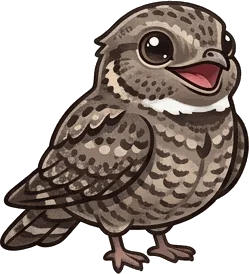
A Common Poorwill sounds like its name: a soft, mellow, two-note whistle, poor-will, repeated over and over from the ground or a low rock after dark. Up close you can hear a faint third note, poor-will-low. It calls from dusk to dawn on dry, brushy hillsides, rocky mesas and desert washes across the western United States, most persistently in spring and on moonlit nights. It is softer than the loud, three-part chant of a whip-poor-will, and it comes from much drier country.
The birder's mnemonic
“poor-will” From a distance you hear two notes. Get closer and a quiet third syllable appears at the end, so the bird is really saying poor-will-low.
What the call sounds like: a soft poor-will
The poorwill's song is a monotonous, mellow whistle of two notes, poor-will, falling from the first note to the second and repeated again and again into the night. At close range a third, softer syllable can be heard, which Wikipedia writes as poor-will-low and Animal Diversity Web as poor-will-ow. It sits around 1.5 kilohertz in pitch.
Both sexes give the same call, and researchers cannot tell a courtship version from any other. It works as a song all the same: males use it to advertise their territory and attract a female, and playing a recording inside a territory will bring a male in to investigate. Calling goes on through much of the year but grows more frequent and longer during the breeding season, especially early on, when males call from evening through the night until dawn.
Poorwills usually call from the ground or a low perch such as a rock. They may go quiet when they hear an owl, which is sensible, since owls are among their predators.
Other sounds: chucks and a snake impression
In flight a poorwill sometimes gives a short chuck. The strangest sound it makes comes from a disturbed adult at the nest: it tumbles, opens its mouth and hisses, an act that appears to mimic a snake. Wing clapping has been reported once, but nobody knows what it means.
When and where you hear it
This is a western bird, found from southern Canada through the western United States and into Mexico. Listen in dry, open country: hills with scattered brush, rocky mesas, grassland near rock outcrops, stony desert slopes with very little growing on them, the washes of the Sonoran Desert and open, scrubby pine forest. It is mostly a bird of lower elevations, though some nest much higher.
Northern birds migrate south between September and November and return in April and May. In the Southwest some stay all year, and southern breeders arrive as early as February and March. Poorwills hunt from dusk to dawn, sitting on the ground or a low perch and making short upward flights after moths and beetles, and they hunt more on moonlit nights than dark ones, which is also when you are most likely to hear them calling.
Nesting is minimal. The eggs, usually two, go straight onto bare soil, gravel or rock, often in shade, with no nest at all, and the parents may move the eggs or chicks a few feet every couple of days.
The bird that hibernates
The Common Poorwill was the first bird known to hibernate. In cool weather it can drop into torpor, lowering its body temperature, heart rate and breathing to save energy, and at the southern edge of its US range it spends much of the winter this way, tucked into piles of rocks. In the 1940s the naturalist Edmund Jaeger found a hibernating poorwill in California's Chuckwalla Mountains, and the first bird documented hibernating in the wild stayed torpid for at least 85 days. The Hopi name for the bird means "the sleeping one." Meriwether Lewis had recorded torpid poorwills in North Dakota in 1804, but nobody grasped the significance.
What it looks like
The smallest nightjar in North America, short-tailed and neckless-looking, with a short bill and rounded wings. It is mottled gray, brown and black, a perfect match for gravel and dead leaves, with a bold white band across the lower throat. In flight it shows small white or buff corners on the tail. By day it sits motionless on the ground, trusting its camouflage.
Birds that sound similar
- ?Mexican Whip-poor-will
In the Southwest's mountains, this bird calls a loud, rhythmic whip-poor-will, three syllables repeated over and over, from pine-oak woodland at middle elevations. The poorwill's two mellow notes come from lower, drier, brushier slopes.
 Eastern Whip-poor-will
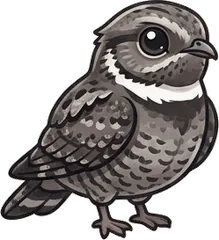
The Eastern Whip-poor-will's loud, rhythmic whip-poor-will has three strong beats and comes from moist eastern woodlands. A poorwill sounds softer and mellower, with two clear notes and only a faint third one up close.
Where the Common Poorwill card lives
The Common Poorwill is not in the top 100 of any single state album, so it lives in the national album of all 800 birds, where it counts as rare. Catching one anywhere in the country adds it there.
 Heard one? Open Warble, tap the green button while it sings, and the Common Poorwill card flips into your album. Get the app free.
More about the Common Poorwill on this site
Questions people ask
What bird says poor-will at night?
The Common Poorwill, a small nightjar of the western United States. It repeats a soft, two-note poor-will from the ground or a low rock between dusk and dawn, on dry brushy hillsides, rocky mesas and desert washes, mostly in spring and summer.
Does the Common Poorwill really hibernate?
Yes. It was the first bird known to do so. In cool weather it can enter torpor for long periods, and one bird found hibernating in the wild stayed torpid for at least 85 days. The Hopi name for it means "the sleeping one."
Is a poorwill the same as a whip-poor-will?
No. They are related nightjars, but different species. The whip-poor-wills call a loud, three-beat whip-poor-will from woodland, while the poorwill gives a softer two-note call from dry, open country in the West.
When do poorwills call?
From dusk to dawn, most often in spring when males are setting up territories. They call in other seasons too, and they are especially active on moonlit nights, when they also hunt more.
Sources
- National Audubon Society, Guide to North American Birds: Common Poorwill. www.audubon.org/field-guide/bird/common-poorwill
- Wikipedia: Common poorwill (call, torpor history, breeding). en.wikipedia.org/wiki/Common_poorwill
- Animal Diversity Web: Phalaenoptilus nuttallii, common poorwill (vocalizations, migration timing, torpor). animaldiversity.org/accounts/Phalaenoptilus_nuttallii/
- National Audubon Society, Guide to North American Birds: Mexican Whip-poor-will. www.audubon.org/field-guide/bird/mexican-whip-poor-will
- National Audubon Society, Guide to North American Birds: Eastern Whip-poor-will. www.audubon.org/field-guide/bird/eastern-whip-poor-will